What Does a CSV Professional Actually Do?
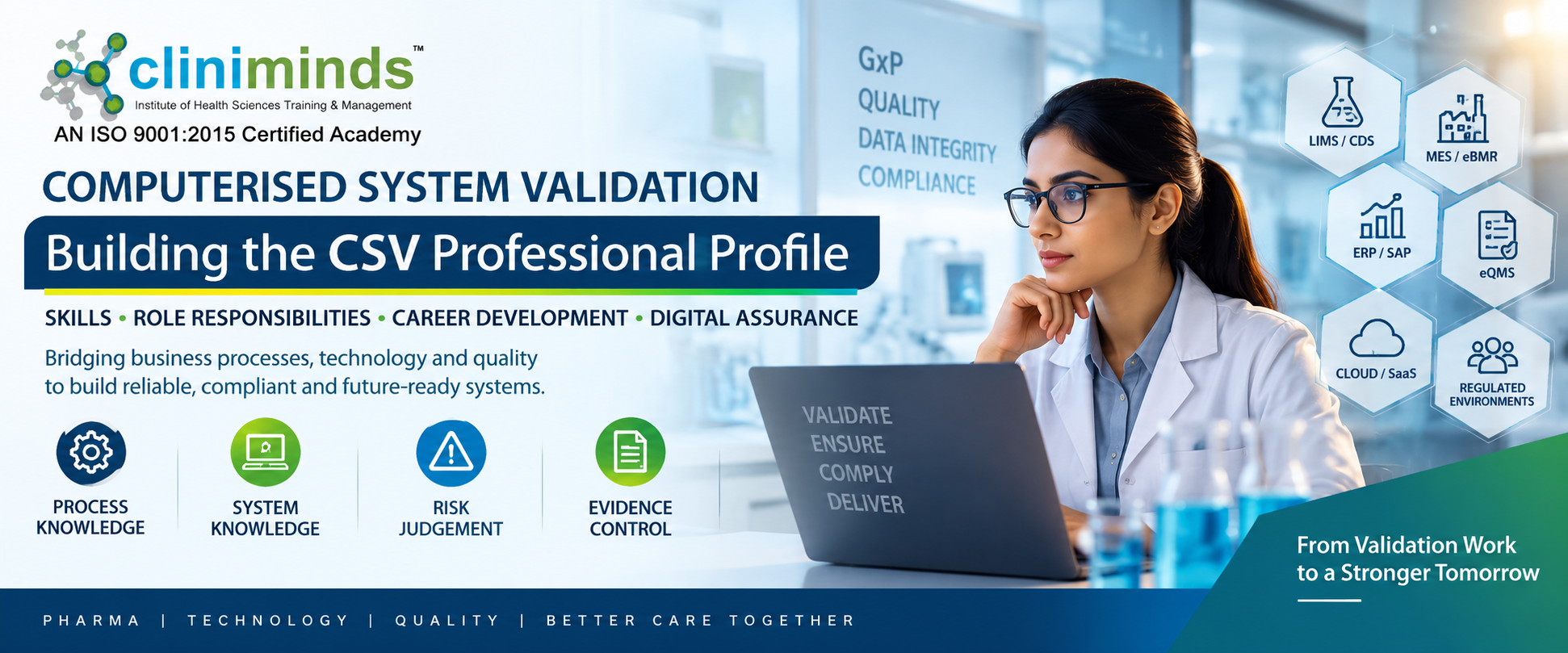
CSV work sits between business processes, computerized systems and quality requirements. The professional is expected to understand what the system is used for, identify meaningful risks and help build evidence that the system can be relied upon.
The role is broader than test execution. It may involve requirements, risk assessment, documentation, vendor interaction, deviations, change control, data integrity and communication with QA, IT and business teams.
CSV PROFESSIONAL AT A GLANCE PROCESS KNOWLEDGE → SYSTEM KNOWLEDGE → RISK JUDGEMENT → EVIDENCE → CONTROL |
The Professional Skill Set
Capability |
Workplace question |
| Process |
What is the system used for? |
| Technology |
How does the system support the process? |
| Risk |
What could affect product, data or compliance? |
| Evidence |
What must be demonstrated and recorded? |
| Control |
How will the system remain reliable after release? |
| Projected market by 2030 |
~US$130 billion |
A practical CSV profile combines four areas: regulated-process knowledge, technology understanding, validation practice and clear quality documentation. The balance changes with the role and the system.
Strong professionals can move between process owners, technical teams and quality functions without losing sight of intended use, risk or evidence.
SYSTEMS YOU MAY ENCOUNTER LIMS / CDS • MES / eBMR • ERP / SAP • eQMS • SCADA / DCS • Veeva • CLOUD / SaaS |
Responsibilities Across a CSV Project
Project activity |
Professional contribution |
| Intended use |
Understand the process and GxP impact |
| Risk assessment |
Identify critical functions and controls |
| Requirements |
Challenge unclear or incomplete requirements |
| Testing |
Select and execute appropriate evidence |
| Traceability |
Link requirements, tests and results |
| Deviation / CAPA |
Investigate issues and document actions |
| Change control |
Assess impact before changes are implemented |
| Data integrity |
Review access, audit trails and records |
| Periodic review |
Assess whether the system remains controlled |
Knowledge That Supports the Role
Knowledge area |
Why it matters in the role |
| GxP / GMP |
Connect system controls to regulated processes |
| Part 11 / Annex 11 |
Understand electronic-record and GMP expectations |
| GAMP 5 |
Apply a risk-based lifecycle approach |
| Data integrity |
Protect the reliability of electronic records |
| Risk management |
Focus effort on critical functions |
| CSA |
Use appropriate assurance for intended use and risk |
| CSA |
Modern risk-based software assurance |
Skills That Matter at Work
- Regulatory knowledge: GxP, Part 11 and Annex 11.
- Validation practice: lifecycle planning, requirements and testing.
- Risk and quality: risk assessment, deviations, CAPA and change control.
- Documentation: URS, specifications, test evidence, traceability and reports.
- Data integrity: ALCOA+, audit trails and electronic records.
- Systems: LIMS, MES, ERP, CDS, eQMS and cloud applications.
- Professional skills: communication, review, problem solving and stakeholder coordination.
- Modern assurance: CSA and risk-based critical thinking.
Choose Your Starting Point
Starting point |
Transferable strength |
Build next |
| Pharma / QA / QC |
Process and quality knowledge |
Systems and validation |
| Life Sciences / Biotech |
Scientific and laboratory knowledge |
GxP, CSV and data integrity |
| IT / Computer Science |
Software and systems |
GxP, validation and quality |
| Engineering / Automation |
Technical and equipment knowledge |
GxP and validation |
LIFE-SCIENCE ROUTE Process / GxP → CSV → Systems → Data Integrity → Assurance |
TECHNOLOGY ROUTE IT / Engineering → GxP → Validation → Quality Systems → Assurance |
Where CSV Skills Are Used
CSV capabilities are useful wherever computerized systems support regulated work. Opportunities can sit within pharma and biotech operations, laboratories, clinical environments, quality organizations, technology teams, CROs, CDMOs and consulting projects.
Work environment |
Typical CSV focus |
| Pharma / biotech |
Manufacturing, quality and laboratory systems |
| Clinical / regulated services |
GxP applications and electronic records |
| IT / consulting |
Validation projects, IT quality and GxP systems |
| CRO / CDMO |
Client systems and regulated operations |
| Digital quality |
Assurance platforms, data and connected systems |
JOB TITLES CSV Associate • CSV Specialist • Validation Engineer • CSV Consultant • IT Quality / GxP Compliance • LIMS / MES Validation • Digital Quality |
How Responsibility Grows
ASSOCIATE |
SPECIALIST |
ENGINEER / CONSULTANT |
SENIOR / LEAD |
MANAGER |
DIGITAL QUALITY |
Specialization can develop around LIMS, MES, SAP, Veeva, laboratory informatics, data integrity, cloud/SaaS, CSA or digital quality. The job title may change while the core skills remain connected.
From Validation Work to Digital Assurance
Earlier emphasis |
Current direction |
| Document completion |
Quality of evidence |
| Fixed test scripts |
Risk-based testing |
| On-premise applications |
Cloud / SaaS environments |
| Validation execution |
Critical thinking + intended use |
| Standalone systems |
Integrated and data-connected systems |
SKILL DIRECTION GxP + CSV → Risk + Data Integrity → CSA → Cloud / SaaS → Integrated Digital Quality |
Skills to Build Next
- Cloud / SaaS — new validation, supplier and control considerations.
- AI / ML — new assurance questions around intended use, data and models.
- Digital validation platforms — validation activities themselves are becoming digital.
- Integrated systems — ERP + MES + LIMS + QMS + data platforms increase complexity.
- Cybersecurity awareness — technology risk increasingly intersects with quality and data integrity.
PRACTICAL TAKEAWAY As validation becomes more digital, professionals need stronger skills in systems, risk, data and evidence—not only documentation. |
A Career Built on Transferable Skills
CSV is a practical career area for people who can connect regulated work with technology. The entry point may be pharma, life sciences, IT, engineering or quality, but progression depends on building capability across systems, risk, evidence and communication.
THE DEVELOPING PROFILE GxP + Systems + Validation + Risk + Data Integrity + Communication + Digital Assurance |
References
- U.S. Food and Drug Administration. 21 CFR Part 11 – Electronic Records; Electronic Signatures – Scope and Application Guidance for Industry.
- European Commission. EudraLex Volume 4 – Good Manufacturing Practice Guidelines, Annex 11: Computerised Systems.
- International Society for Pharmaceutical Engineering (ISPE). GAMP 5: A Risk-Based Approach to Compliant GxP Computerized Systems.
- Cliniminds. Computerised System Validation Training Program and Industry Training Resources.