


Chemistry, Manufacturing and Controls (CMC): The Foundation of Drug Regulatory Affairs
Introduction: Beyond Drug Approval
Developing a medicine is only one part of bringing it to market. Pharmaceutical companies must also demonstrate that the medicine can be manufactured consistently, meets established quality standards, remains stable throughout its shelf life and is suitable for its intended use. This is where Chemistry, Manufacturing and Controls (CMC) becomes essential to Drug Regulatory Affairs (DRA).
CMC refers to the scientific and technical information that describes a drug’s composition, manufacturing process, quality testing, specifications and stability. Regulatory authorities review this information to assess whether a pharmaceutical product can be manufactured with consistent quality and whether the supporting evidence is adequate for its intended stage of development and use. The US Food and Drug Administration (FDA) requires appropriate CMC information in drug applications, including investigational applications, with the level of detail depending on the product and development stage.
Why CMC Matters in Drug Regulatory Affairs
Drug Regulatory Affairs professionals serve as a link between pharmaceutical companies and regulatory authorities. Their responsibility is not limited to preparing and submitting documents; they must also ensure that the scientific evidence supporting a medicine meets the applicable regulatory requirements.
CMC plays a central role in this process because the quality of a medicine depends on more than its active ingredient. Raw material quality, manufacturing conditions, formulation, analytical methods, packaging and storage can all influence the final product. A well-prepared CMC dossier helps demonstrate how these factors are controlled and how the manufacturer maintains product quality from batch to batch.
For regulatory professionals, understanding CMC is therefore important when preparing submissions, responding to regulatory queries, supporting inspections and managing post-approval changes. Incomplete, inconsistent or inadequately justified CMC information may lead to additional questions, delays in approval or difficulties in maintaining compliance.
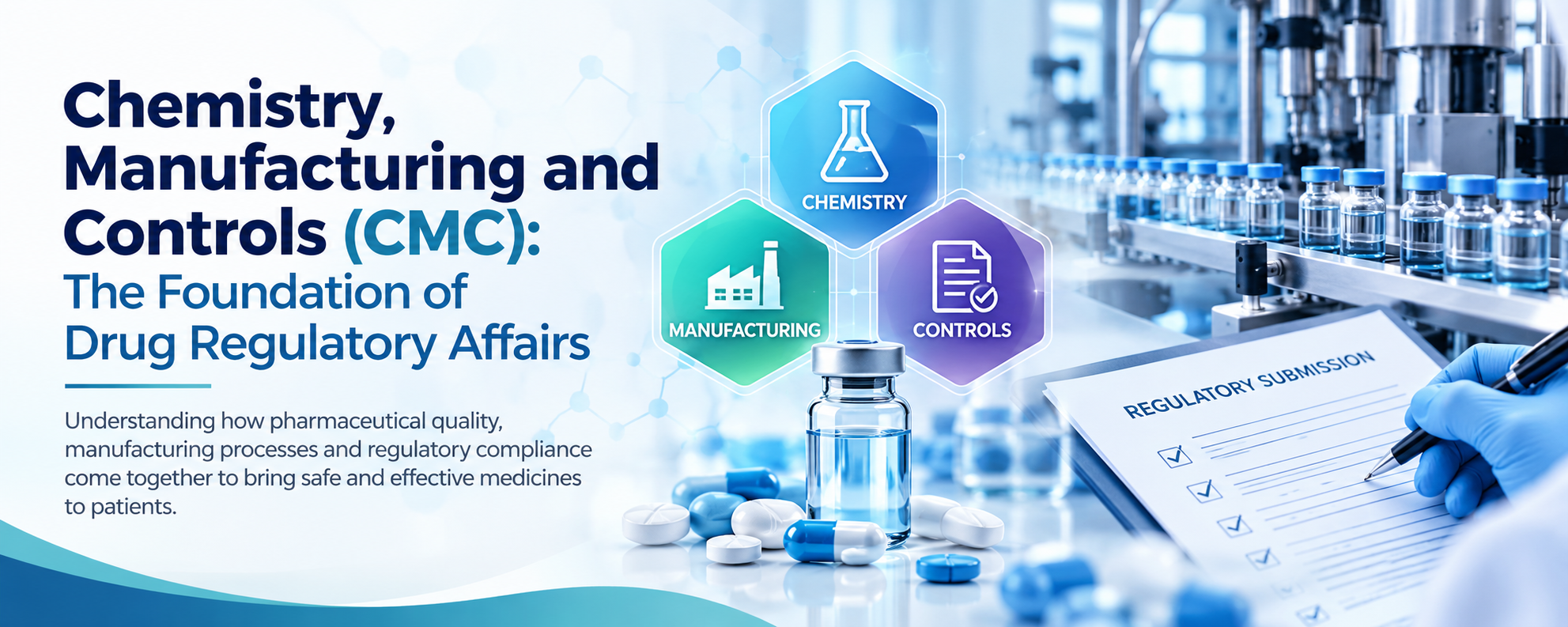
The Three Pillars of CMC

Chemistry
This covers the identity, composition, properties, purity and impurity profile of the drug substance and drug product. Analytical testing helps establish whether the medicine meets its defined quality specifications.

Controls
This includes specifications, analytical procedures, acceptance criteria, stability studies and other measures used to ensure that each batch meets the required quality standards throughout its intended shelf life.

Manufacturing
This explains how the active pharmaceutical ingredient and finished dosage form are produced. It includes manufacturing processes, facilities, equipment, process controls and relevant validation evidence.
Together, these elements provide regulators with a scientific understanding of how a medicine is developed, manufactured and controlled. The International Council for Harmonisation (ICH) guidelines, particularly Q8 on Pharmaceutical Development, Q9 on Quality Risk Management and Q10 on the Pharmaceutical Quality System, provide important principles for establishing and maintaining pharmaceutical quality.
CMC in Regulatory Submissions and Product Lifecycle Management
CMC information forms an important part of the Common Technical Document (CTD), the internationally harmonised format used for many pharmaceutical marketing applications. Module 3 contains the principal quality information relating to the drug substance, drug product, manufacturing process, control strategy and stability data.
However, CMC is not limited to the initial application. After a medicine receives regulatory approval, manufacturers may need to change suppliers, modify manufacturing equipment, transfer production to another site, revise analytical methods or introduce process improvements. These changes must be evaluated and reported or submitted for approval according to the applicable regulatory requirements.
Regulatory professionals must understand the scientific impact of such changes, coordinate with quality and manufacturing teams, and ensure that the appropriate regulatory pathway is followed. ICH Q12 provides a framework for managing technical and regulatory considerations throughout the pharmaceutical product lifecycle.
The Growing Importance of CMC Expertise
As pharmaceutical development becomes increasingly complex, CMC expertise is valuable across generic medicines, innovative drugs, biologics and advanced manufacturing processes. Companies need professionals who can interpret technical data, understand quality requirements, prepare clear regulatory documentation and communicate effectively with cross-functional teams.
For individuals pursuing a career in Drug Regulatory Affairs, learning CMC can help build a stronger understanding of the relationship between pharmaceutical science and regulatory decision-making. A regulatory professional who understands why particular data are required—not just where to place them in a dossier—is better equipped to prepare scientifically sound submissions and address regulatory questions.
CMC knowledge is particularly relevant to regulatory affairs, CMC regulatory strategy, regulatory submissions, pharmaceutical quality, technical documentation and post-approval change management. Although specific responsibilities vary by role, a sound foundation in CMC can help professionals work more confidently across these areas.
Conclusion: Connecting Pharmaceutical Science with Regulatory Compliance
CMC is much more than a technical section of a drug application. It provides the evidence that a medicine can be manufactured with appropriate quality controls and maintained in a state of control throughout its lifecycle. Within Drug Regulatory Affairs, this information supports regulatory assessment, facilitates communication with authorities and contributes to the availability of quality medicines.
For aspiring and working regulatory professionals, developing a clear understanding of CMC is an important step towards building practical regulatory knowledge and contributing effectively to pharmaceutical product development and compliance.
References
- International Council for Harmonisation (ICH). Quality Guidelines — including Q8, Q9, Q10, Q11 and Q12. View ICH Quality Guidelines.
- US Food and Drug Administration (FDA). IND Applications for Clinical Investigations: Chemistry, Manufacturing, and Control (CMC) Information. Read the FDA guidance.
- European Medicines Agency (EMA). Quality Guidelines: Pharmaceutical Development. Read EMA guidance.
- US Food and Drug Administration (FDA). Q10 Pharmaceutical Quality System. Read the FDA guidance.
- European Medicines Agency (EMA). ICH Q8, Q9 and Q10 — Questions and Answers. Read EMA guidance.
- Cliniminds - Drug Regulatory Affairs Training Program and Industry Training Resources.